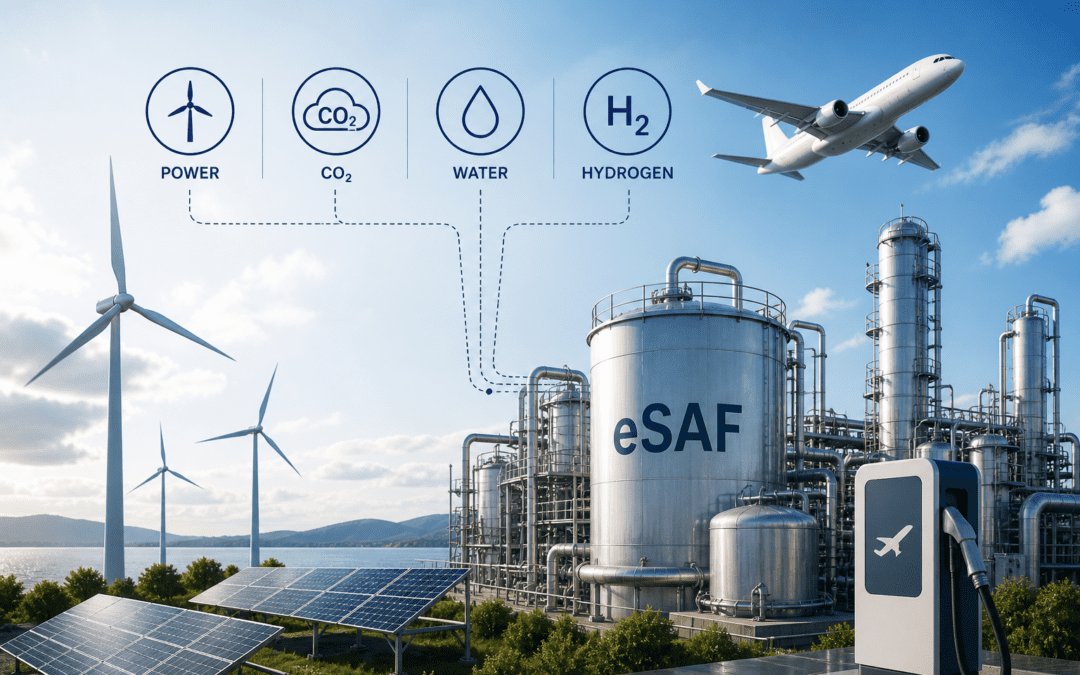
Sustainable aviation fuel – particularly eSAF – has moved rapidly from a niche topic into the centre of energy and decarbonisation discussions. It now sits at the intersection of power, hydrogen, CO₂, infrastructure, policy and geopolitics.
There is no shortage of commentary on pathways and technologies, but in practice one thing still seems to be missing: a shared intuition for the scale of eSAF production.
Why understanding eSAF scale is still a challenge
In day-to-day conversations, the same questions come up repeatedly:
How much power is actually required to produce meaningful volumes of eSAF?
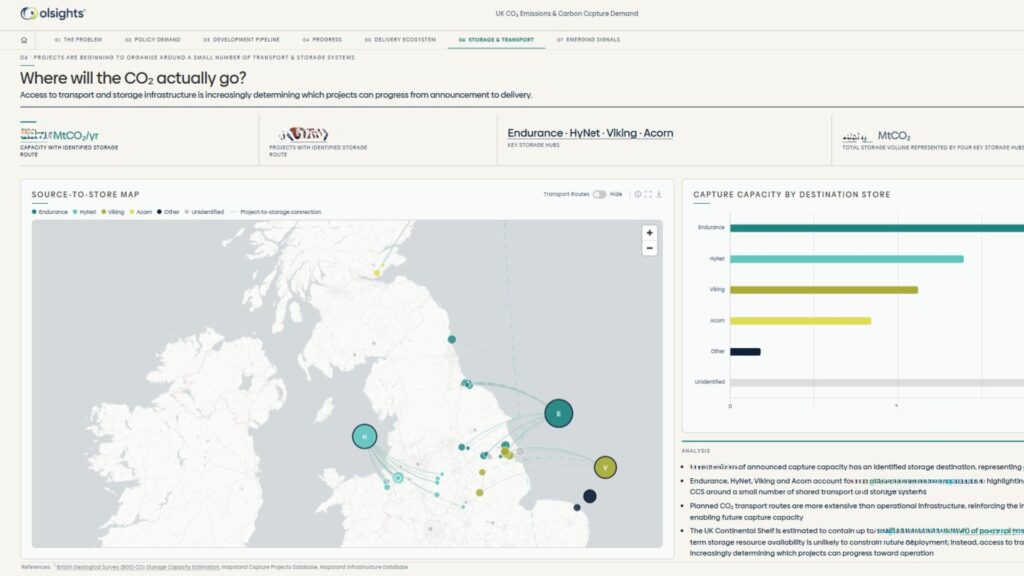
What does that imply in terms of CO₂ supply?
How much water is involved?
How do different pathways – integrated eSAF, e-methanol, or finishing hubs – really compare when reduced to first principles?
Even for people working in the space, these are not always easy questions to answer quickly.
The typical approach is to build a spreadsheet, pull together a set of assumptions from different sources, and work through the arithmetic.
That works, but it is often slow, fragmented, and not always transparent to others involved in the conversation.
A simple way to explore eSAF production scenarios
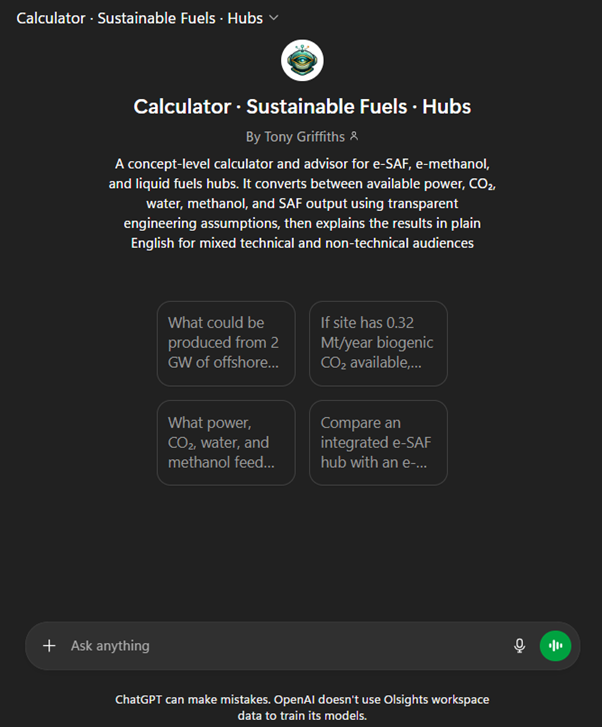
As a small experiment, we have developed a simple “liquid fuels hub” calculator using a Custom GPT, now available in the GPT Store.
It is based on a consistent set of mid-range engineering assumptions and allows users to explore questions such as:
- What a given amount of wind power could produce as eSAF or methanol
- What level of power, CO₂ and water would be required to reach a particular fuel output
The intention is not to replace detailed engineering design.
Rather, it provides a fast, consistent way to sense-check scenarios and make the underlying relationships more visible.
By keeping assumptions explicit, it becomes easier to understand why a particular result looks the way it does, and to compare different options on a like-for-like basis.
Making eSAF calculations more accessible
What has been particularly interesting is not just the output of the tool, but the way of working it enables.
Instead of each calculation existing as a one-off in a spreadsheet or notebook, the logic becomes reusable and conversational.
This allows:
- Rapid iteration of “what if” questions
- Greater transparency in how results are derived
- Lower barriers for non-specialists to engage with complex systems
Key insights from exploring eSAF scenarios
Working through a number of real and hypothetical cases has reinforced several consistent themes:
- In many scenarios, CO₂ availability is as constraining as, or more constraining than, power
- Hydrogen, while often described as an intermediate, dominates both cost and system design
- The choice between producing eSAF directly or producing methanol as an intermediate is often driven as much by logistics and infrastructure as by chemistry
- Locations suited to “finishing” fuels can behave very differently to those suited to fully integrated production
The scale of eSAF production
Perhaps most importantly, the exercise highlights just how large the scale of eSAF production needs to be to make a meaningful contribution.
When translated into:
- Gigawatts of power
- Millions of tonnes of CO₂
- Daily water requirements
…the numbers quickly move beyond what many stakeholders intuitively expect.
From simple tools to system-level understanding
This kind of tool is only a starting point, but it points towards a broader shift.
As the energy transition becomes more system-level and data-driven, there is growing value in approaches that combine engineering logic with interactive, accessible interfaces.
The next step is to connect these types of calculations with:
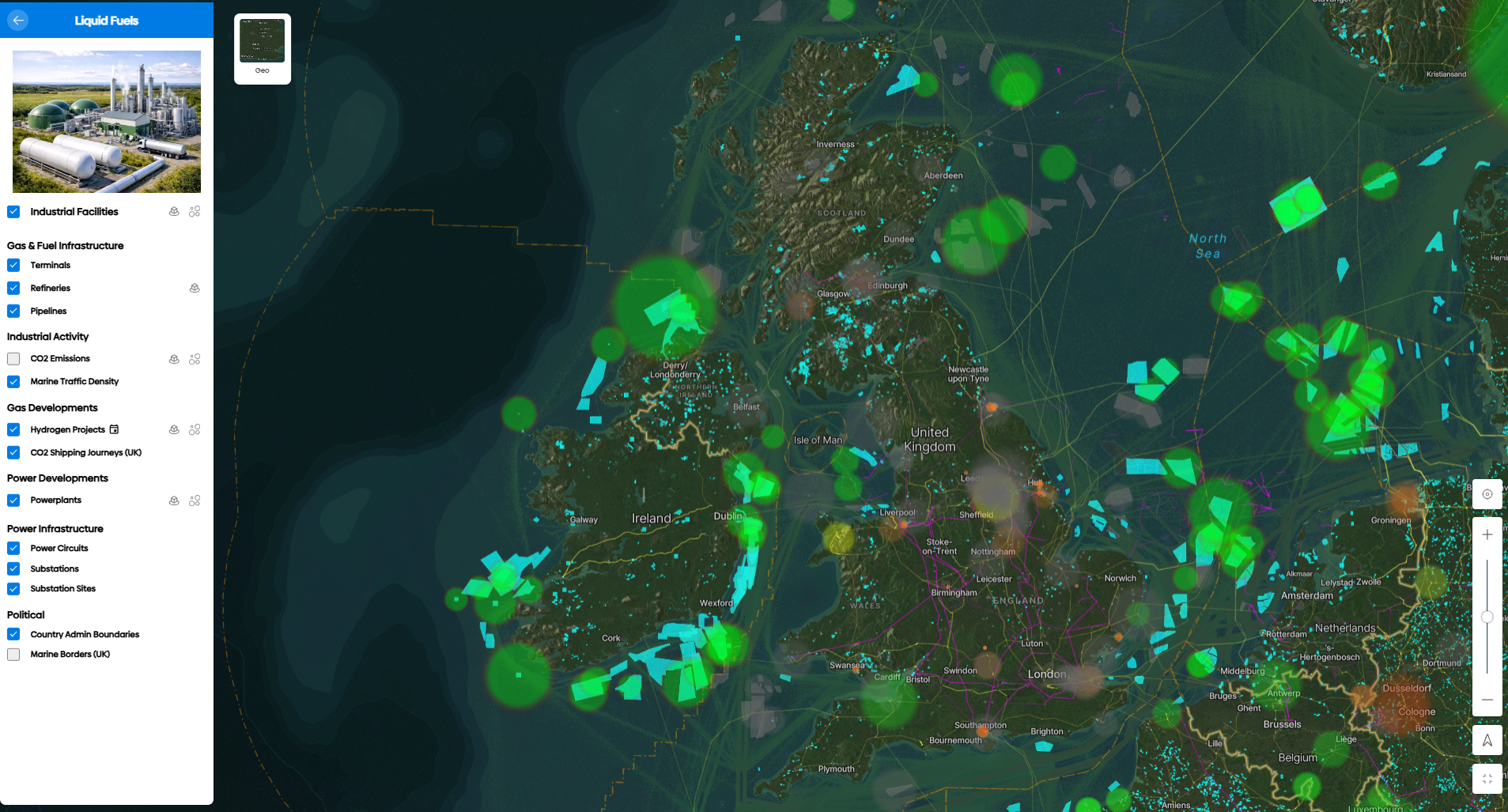
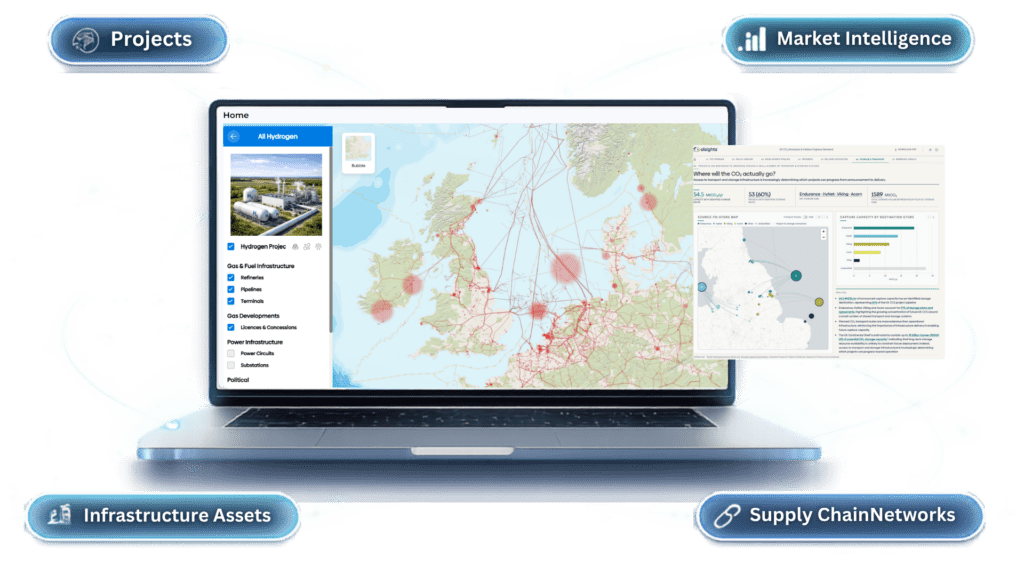
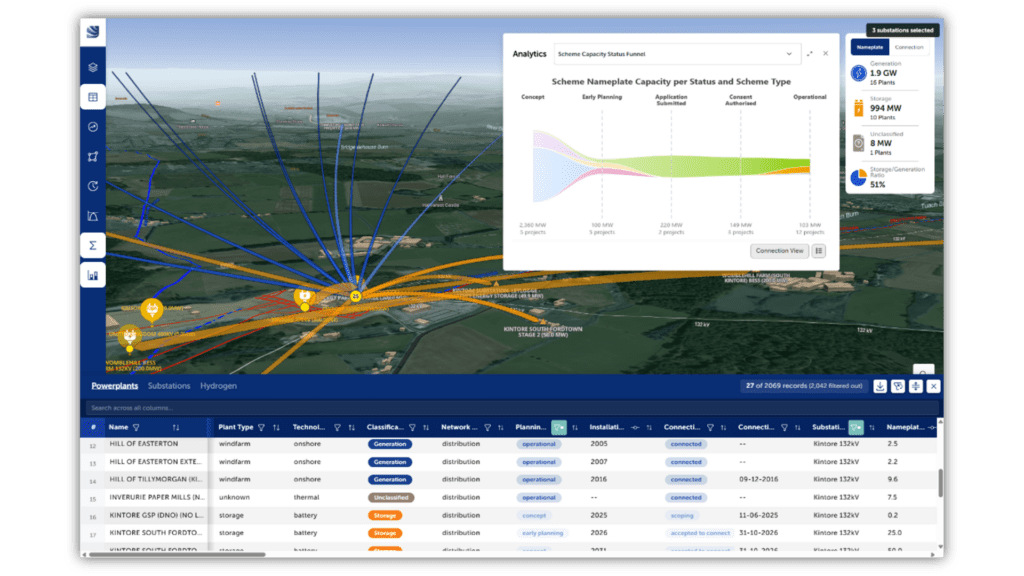
- Spatial data
- Infrastructure constraints
- Real-world project pipelines
Ultimately, this leads towards more automated ways of evaluating and comparing energy system options.
Get in touch
Explore the eSAF calculator for sustainable fuels hubs:
https://chatgpt.com/g/g-69c016de403c8191b44bf29b6a5c048d-calculator-sustainable-fuels-hubs
If you are working in sustainable fuels, hydrogen, CO₂ infrastructure or energy system planning, we would be interested to hear whether this kind of approach is useful, and where it could be taken next.